
Understandinggut health
Your large intestine holds roughly as many bacterial cells as there are human cells in your entire body. That community digests the fiber you can't, and it shifts with what you eat, how you sleep, how stressed you are, and what medication you've taken.
This page is general education, not a product pitch. It covers what's actually well-established about digestive balance, what the evidence supports doing about it, and — at the end — where our formula fits. Where research is early, we say so.
Common signs of digestive imbalance
Four everyday signals — deliberately a short list. Plenty of pages in this category tie gut health to fatigue, skin, mood and sleep; those are broader research topics, not things a daily fiber-and-probiotic stick has been shown to fix.
Bloating
Visible or felt distension, often building through the day or after meals.
Irregularity
Bowel habits that swing, stall, or stop being predictable week to week.
Post-meal heaviness
Fullness out of proportion to the meal — the “still sitting there” feeling.
Sluggish digestion
Food moving slowly, with discomfort or gas that lingers longer than it should.
Why digestive balance gets disrupted
Four well-documented pressures. None of these is a diagnosis, and none of them is solved by one product.
A modern diet with very little fiber
Most adults eat well under the recommended fiber intake. Fiber is what gut bacteria actually eat; when it's scarce, some species decline and, in mouse models, the microbes start grazing on the intestinal mucus layer instead.2, 3
Stress, via the gut–brain axis
Stress changes gut motility, secretion and sensitivity through the same nerve and hormonal pathways that carry signals the other way. It's one of the best-documented reasons digestion feels different in a hard week.6
Antibiotics
Antibiotics are sometimes necessary and they are not selective. Repeated courses can shift the gut community measurably, and recovery is incomplete and highly individual.4
Illness and recovery
An acute gut infection, a hospital stay, or a stretch of poor eating and sleep during recovery all disturb the same system at once — which is why digestion is often the last thing to normalise.5
What actually helps
Five questions worth being able to answer before you buy anything in this aisle — ours included.
The gut–brain connection
The gut and the brain are in constant two-way conversation — through the vagus nerve, immune signalling and microbial metabolites. It's one of the most active areas in gastroenterology, and the animal evidence is genuinely striking.
Human evidence is younger. Reviews of this field are consistent about the caveat: strain-specific, small trials, mixed replication. So we'll say the honest thing: Supergut is not a mood, sleep or stress product, and nothing in today's formula is dosed for that.
Where Nami Supergut fits in
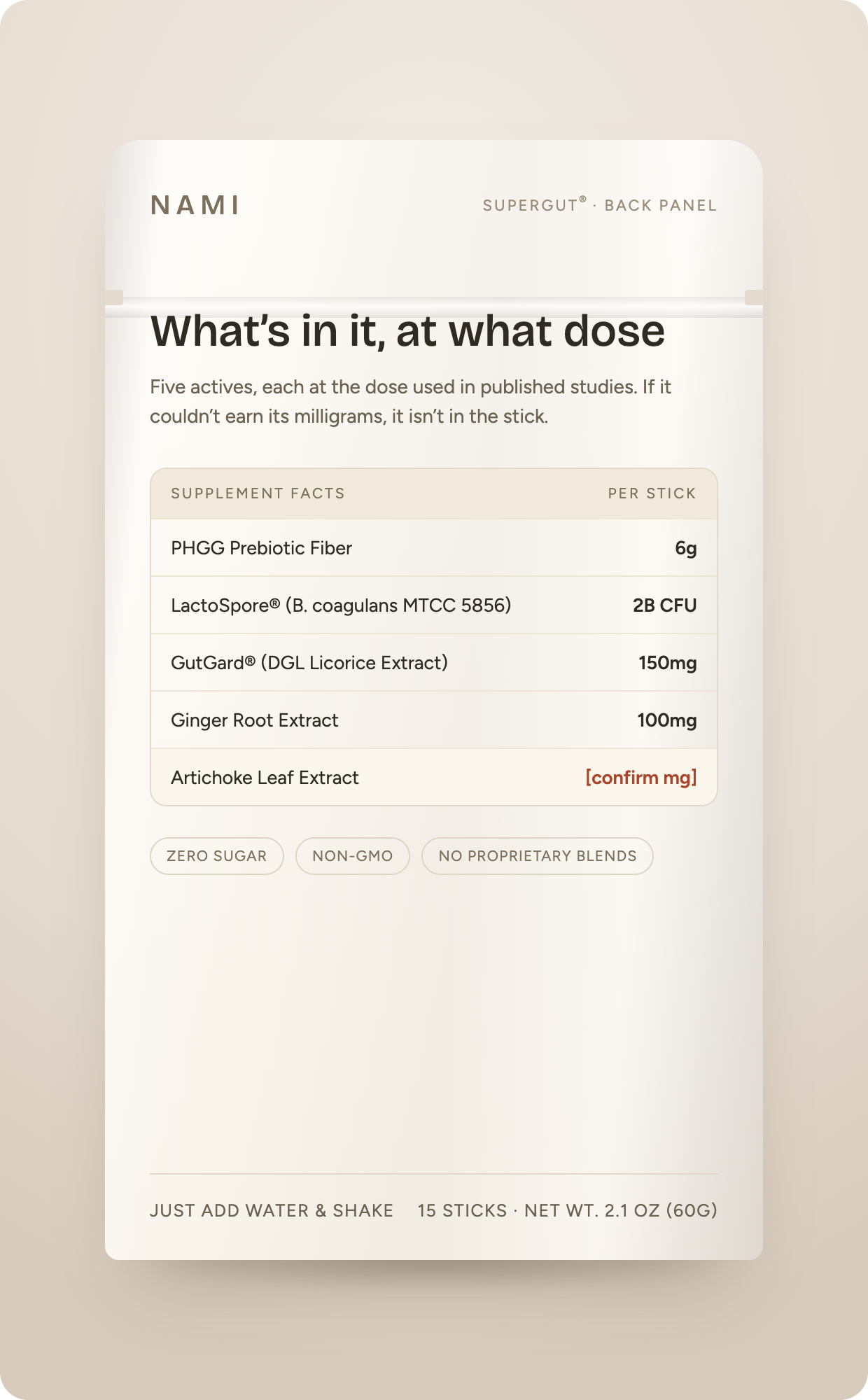
One stick, five actives, each at the dose used in published research. It targets four things: bloating, regularity, post-meal comfort and motility. That's the whole claim.
References
General-science citations for this page, plus the trials behind each active in our formula. Where a figure is still being confirmed, it appears as TBC rather than an estimate.